

How to Let Go of Clothes You Don’t Wear (When You Feel Guilty About the Money)


I know how this feels.
You start cleaning out your closet and before long there is a pile of clothes on the floor. Some still have tags on them, some used to fit, and some felt like such a good idea at the time. And as you look at it all, one thought keeps coming up.
I wasted so much money on clothes I do not even wear.
That feeling can be so uncomfortable that you start circling the pile, pulling a few things back out. Maybe this one stays. Maybe that one just needs the right occasion. Letting everything go all at once suddenly feels too final.
But keeping clothes you do not wear does not protect the money you spent. It only keeps the guilt alive.
Clothes only have value when they are being worn. When something sits unused in your closet, it is not preserving its worth. In many cases, it is actually more valuable in someone else’s closet, where it can be worn, used, and appreciated again.
Understanding why this happens is the key to finally letting go without shame, panic, or regret.
Why It’s So Hard to Let Go of Clothes You Don’t Wear
Most women assume the problem is willpower or discipline. They think they just need to be more decisive or more ruthless with their closets.
In reality, this struggle has very little to do with clutter and everything to do with how our brains process money and loss.
There is a well documented psychological pattern that explains exactly what is happening, and once you understand it, the guilt starts to loosen its grip.
FREE DOWNLOAD
Get the Wardrobe Essentials Checklist
A simple wardrobe inventory to help you see what you own, spot the gaps, and shop with a plan. I’ll email it to you when you subscribe.
The Sunken Cost Fallacy and Why It Keeps You Holding Onto Clothes
Psychologists call this pattern the sunken cost fallacy.
The sunken cost fallacy is the tendency to hold onto something simply because you have already invested in it. That investment might be money, time, effort, or even hope. Once those resources are spent, our brains resist letting go, even when the item itself no longer serves us.
In your closet, the sunken cost fallacy sounds like this:
- I spent too much money to get rid of this.
- I have not worn it yet, so I should keep trying.
- If I let it go, I wasted the money.
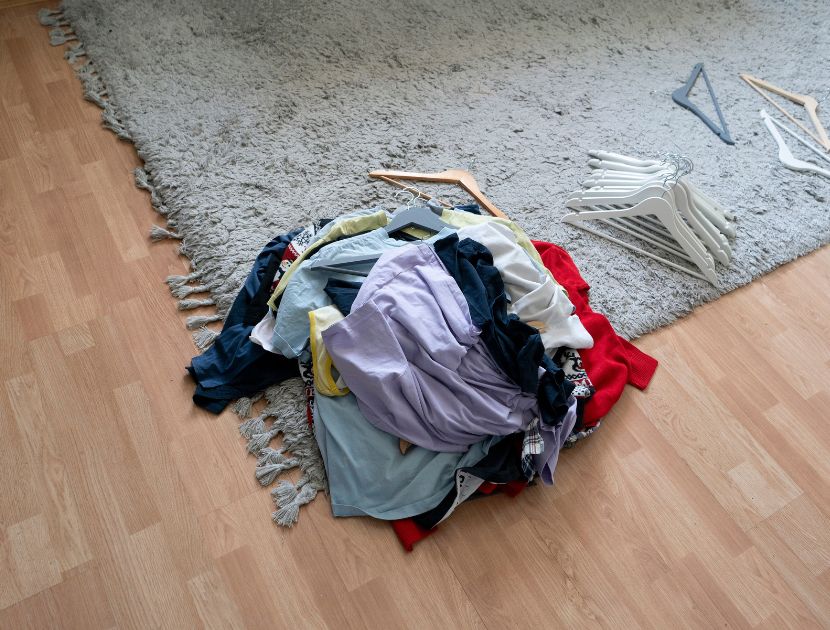
But here is the truth that is hard to accept at first.
The money is already gone.
Keeping the clothes does not recover it. It does not justify it. It does not make the purchase worth it. All it does is keep the cost emotionally active every time you open your closet.
Why We Feel Guilty Letting Go of Clothes We Spent Money On
Clothes are especially vulnerable to the sunken cost fallacy because they are personal and visible.
Clothes Carry Identity and Past Versions of Ourselves
Many purchases are tied to who we thought we would be. A certain job, a certain body, or a certain season of life. Clothing often represents intention and optimism, not just function. When we buy something, we are buying into a version of ourselves we believe is coming next.
Letting go can feel uncomfortable because it is not just about the clothes. It can feel like admitting that a chapter has changed or that a plan did not unfold the way we expected. That does not mean the purchase was foolish or naive. It means life moved, and your wardrobe has not caught up yet.
Releasing clothes connected to past versions of yourself is not giving up. It is acknowledging where you are now and allowing your wardrobe to support that reality instead of quietly reminding you of what no longer fits.
Clothes Are a Constant Reminder of Money Spent
Unlike a bad investment or an unused subscription, clothing is something you see every day. Every time you open your closet or get dressed, you are confronted with items that represent money spent and decisions you might wish you had made differently.
This constant visibility keeps the guilt active. Even if you are not consciously thinking about the money, your brain registers the unfinished decision. Over time, that creates friction, decision fatigue, and low level stress around getting dressed.
Letting go removes that daily reminder. It does not erase the past purchase, but it does stop asking you to relive it over and over again.
Why Keeping Unworn Clothes Feels Like the Responsible Choice
The higher the price tag, the stronger the urge to keep something just in case. Holding onto unworn clothes can feel practical, cautious, and financially responsible. It can feel safer than admitting the money is gone.
But responsibility is not measured by how long something stays in your closet. An expensive mistake does not become more valuable with time. It becomes heavier. Items that sit unworn for years are not being used, loved, or justified. They are simply occupying space and attention.
Letting go is often the more honest and responsible decision. It allows you to close the loop on the purchase, learn from it, and move forward without continuing to pay for it emotionally.
Keeping the Clothes Does Not Protect the Money You Spent
This is the most important point in the entire conversation.
You do not honor money by keeping clothes you do not wear.
The cost is sunk whether the item stays in your closet or leaves it. What changes is how long you continue to pay for it emotionally.
Every unworn item carries an ongoing cost:
- Guilt when you see it
- Decision fatigue when getting dressed
- A sense of unfinished business
- Quiet self criticism for wasting money
Letting go is not careless. It is closure.
Why “Just Get Rid of It” Advice Doesn’t Work When Money Is Involved
Most decluttering advice skips over the financial and emotional reality of this problem. It tells women to be ruthless, decisive, and fast.
That approach often backfires.
When you let go out of pressure or shame, you are more likely to second guess yourself, keep backups just in case, or rebound shop to soothe the discomfort.
Letting go works when it is grounded in understanding, not force.
This is not about having fewer clothes. It is about releasing guilt tied to money that is already spent.
If generic decluttering advice has never worked for you, I go deeper into the mindset side of this in How To Purge Clothes: 7 Mindset Shifts You Need to Edit Your Wardrobe.
How to Let Go of Clothes Without Feeling Like You Wasted Money
How to Decide If You Should Keep a Piece of Clothing
Stop asking why did I buy this.
Start asking:
- Does this support my life right now?
- Does it fit my current body, schedule, and priorities?
- Would I buy it again today?
Past spending does not require lifelong loyalty.
The Difference Between Clothes You’ll Actually Wear and Fantasy Purchases
Some clothes support where you are going. Others quietly keep you stuck.
A growth piece fits into your real life now or very soon.
A fantasy piece requires a different life, body, or identity to justify its place.
Most financial guilt lives with fantasy pieces.
A Simple Rule for Deciding What to Do With Clothes You Don’t Wear
When a piece is tied to money guilt, indecision is what keeps the discomfort alive. The goal here is not to make the perfect choice. It is to make a clear one.
Use it now
Alter it, style it differently, or commit to wearing it within the next 30 days. This is the right choice for pieces that still fit your life and body but have been sidelined by habit or uncertainty.
Release it responsibly
Donate it, resell it, or recycle it intentionally, not resentfully. Clothes only hold value when they are being worn. When something leaves your closet and goes to someone who will actually use it, its value does not disappear. It simply continues elsewhere instead of sitting dormant in your space.
Store it with a boundary
If you are not ready, place it in a time limited holding zone and revisit it in three months. This is not avoidance. It is a conscious pause with an end date. No indefinite limbo.
Making the decision matters more than which option you choose. Clarity is what breaks the cycle of guilt.
How to Let Go of Clothes Without Guilt
Instead of resenting the purchase, acknowledge what it taught you.
- What fabrics you avoid
- What silhouettes do not work
- What your life actually requires
Learning is not waste. It is return on investment.
What You Gain When You Let Go

Letting go of clothes tied to the sunken cost fallacy is not about minimalism or perfection. It is about alignment.
A wardrobe that reflects your current life feels calmer to open. Decisions become easier. Daily stress decreases. Shopping becomes more intentional because you trust yourself again.
You are not required to keep clothes as proof that you tried. You are allowed to move forward lighter.
Where to Start If This Feels Overwhelming
If everything you’ve read makes sense but you still feel stuck, that does not mean you are doing it wrong. Understanding the sunken cost fallacy does not automatically erase the emotions tied to money, identity, and regret. Those reactions took time to build, and they take time to unwind.
This is not a moment for big declarations or dramatic clean-outs. It is a moment for containment.
Start small on purpose.
Choose five items you have not worn in over a year. Not the most expensive pieces. Not the ones tied to major memories. Just five items that quietly sit there and create friction every time you open your closet. Decide their outcome and stop there.
You are not fixing your wardrobe in one afternoon. You are practicing making decisions without punishment.
If and when you are ready for practical guidance, I also share realistic, low-pressure strategies in Closet Clean-Out Tips That Actually Work. Think of it as support for the moment after the permission sinks in, not a checklist you need to follow right now.
Clarity builds momentum when it feels contained. Pressure shuts it down.
You Might Also Like


Want everything I recommend in one place?
Shop my trusted recommendations
ShopMy is where I save and organize the pieces I consistently recommend, including wardrobe staples, standout finds, and brands I have researched, worn, or genuinely trust. Everything here reflects my years of experience in personal style and the same thoughtful approach I use across The Well Dressed Life.
If you are looking for something specific, or want reliable options without the overwhelm, this is where I start.
Browse my ShopMy




I have scored some amazing finds via resale shops and it gives me a lot of joy. My NWT Sorel snow boots are getting daily wear, and that’s just one example. So when it’s my turn to clear out my closet, I want to remind myself that the item could get a lot of love somewhere else, and maybe something that wasn’t working for me anymore might be someone else’s favorite. Gotta pass it on!
When you said “All it does is keep the cost emotionally active every time you open your closet” that really hit home for me. It is so true! Thank you for that nugget of wisdom. That will truly help me look at cleaning out my closet differently. : )
Thank you so much!I’m seriously so happy it resonated with you!
Hi this was the most beautifully written post you’ve done on this topic that I have read! I think you hit it out of the park and I already made some notes to carry forward to edit my wardrobe
Thank you so much for saying that!
Thank you. Well written and very clear step by step action.